Consulting
Service
In modern industrial systems such as mining, building materials production, chemical metallurgy, and construction waste treatment, crushing equipment is the core of the material processing flow. The hammer crusher, as a highly efficient piece of equipment that relies on impact energy to crush materials, is widely used in crushing medium-hard and brittle materials due to its significant advantages such as simple structure, large crushing ratio, and low maintenance costs. It can handle both primary crushing and medium-fine crushing, and performs particularly well in the processing of coal, limestone, shale, and medium-hard ores. The following will analyze its specific role in industrial production from the perspective of its working principle and core mechanism, providing a comprehensive interpretation of this key piece of equipment.
A. Working Principle of the Hammer Crusher The core of the hammer crusher's operation is high-speed impact and grinding crushing. Its operating logic is clear, relying on physical kinetic energy to achieve efficient material pyrolysis.

1. Core Structure and Transmission Mechanism The equipment mainly consists of a rotor, hammer shaft, hammers, impact plates, crushing chamber, casing, and drive unit. The core rotor, the heart of power transmission, consists of a main shaft, a disc, and hammer shafts. The hammers are suspended from the disc via the hammer shafts. Driven at high speed by the motor, the rotor propels the hammers in high-speed circular motion, imparting enormous centrifugal force and impact kinetic energy to the hammers—the energy source for crushing.
2. Crushing Process: Impact—Rebound—Grinding
The entire crushing process is completed continuously within the crushing chamber, primarily in three stages:
* **Instant Impact Crushing:** When material falls from the feed inlet into the high-speed rotating hammer impact area, it is first violently struck by the high-speed rotating hammers. Under the immense impact force, the internal crystal structure of the material is destroyed, instantly fracturing along the grain and cracks, achieving initial particle fragmentation.
* **Secondary Rebound and Collision Crushing:** Under centrifugal force, the fractured material particles are thrown against the impact plates (or liners) on the inner wall of the crushing chamber, resulting in high-speed rebound. After the impact, the particles fly back towards the rotating hammers, creating repeated collisions, impacts, and grinding between the hammers and material, between the material and the impact plates, and between materials themselves. This multi-stage collision further refines the particles.
Grate Screening and Discharge: After multiple impact crushing processes, particles meeting the required size are discharged from the machine casing through the gaps in the grates (bars) at the bottom of the rotor, becoming the finished product. Larger particles, however, are retained within the chamber and continue to be struck and ground by the hammers until they are small enough to pass through the grate gaps.
3. Key Crushing Characteristics
Impact Energy Dominance: Unlike the "compression crushing" of jaw crushers, hammer crushers rely entirely on the kinetic energy of high-speed hammers, resulting in extremely high crushing efficiency.
Self-Grinding Effect: High-speed collisions of materials within the chamber produce a certain degree of self-grinding, helping to reduce the particle size of the finished product.
B. Core Role of Hammer Crusher
Based on the above principles, hammer crushers play a crucial role in industrial production lines, covering multiple key stages from raw material processing to resource recycling.

1. High-Efficiency Material Crushing, Significantly Reducing Particle Size
This is its most basic function. Hammer crushers are primarily used to process brittle materials with medium to low hardness, such as limestone, coal, shale, coal gangue, gypsum, salts, and soft ores. They boast a very high crushing ratio (up to 10-30 or even higher), capable of crushing large materials (feed size up to 500-1000mm) into fine particles in a single pass (output particle size adjustable to 5-50mm). A single unit can complete a multi-stage process from coarse to fine crushing, greatly simplifying production line configuration, shortening material processing cycles, and providing qualified raw materials for downstream processes (such as grinding and smelting).
2. Providing High-Quality Aggregates and Raw Materials, Supporting Infrastructure and Industry
In the construction and building materials sector, hammer crushers are one of the key pieces of equipment for producing sand and gravel aggregates. The finished particles are mostly cubic or nearly spherical, with high bulk density, and the particle size distribution (the proportion of different particle sizes) is easy to control.
In concrete mixing plants: Crushed sand and gravel are the core raw materials for producing high-performance concrete, directly determining the strength and stability of the concrete.
In the cement industry: It is used to crush limestone raw materials to a fine powder state, providing suitable raw material particle size for subsequent grinding and calcination processes.
In the coal industry: It efficiently crushes lump coal, providing uniformly sized power coal for boiler combustion, significantly improving combustion efficiency.
3. Realizing Solid Waste Resource Utilization and Contributing to a Green Circular Economy
Hammer crushers also play an irreplaceable role in the environmental protection field, serving as core equipment for construction waste treatment and comprehensive utilization of mineral resources.
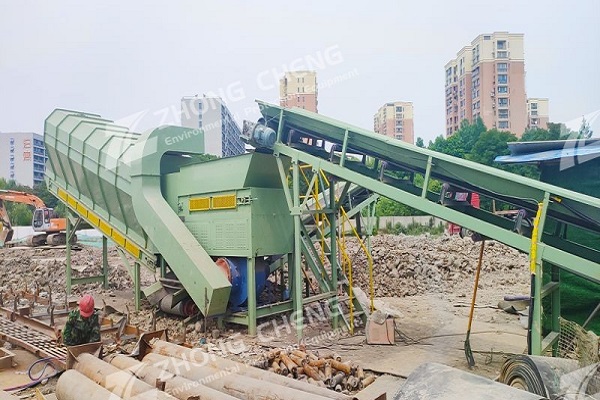
Construction Waste Recycling: Hammer crushers can efficiently crush concrete blocks, waste bricks, and waste reinforced concrete generated during demolition, converting them into recycled aggregates. These recycled aggregates can replace natural sand and gravel in road subbases, brick making, or recycled concrete, achieving "turning waste into treasure" and effectively solving the environmental problem of construction waste surrounding cities.
Ore and Tailings Utilization: In mining, it can crush and process low-grade ores or perform secondary treatment of tailings after mineral processing, improving the recovery rate of mineral resources and reducing resource waste.

4. Simplified Process and Reduced Overall Costs: Hammer crushers have a relatively simple structure, compact size, and are easy to install and maintain. Their significant crushing ratio means that more crushing tasks can be completed with less equipment time, thereby reducing equipment investment, floor space, and energy costs for the production line. For small and medium-sized enterprises or mobile crushing needs, hammer crushers are a highly cost-effective choice. Furthermore, their hammers and liners are mostly made of wear-resistant alloy materials, resulting in a long service life and easy replacement, further reducing daily operating and maintenance costs.
5. High Adaptability and Stable, Reliable Operation: Hammer crushers exhibit extremely high adaptability to materials with low moisture content and no high viscosity. Whether it's dry ore, coal, or brittle rock, it can operate stably. By adjusting the hammer speed, impact plate gap, and grate specifications, users can flexibly control the output particle size to meet the specific process requirements of different industries and products, making it a reliable partner in industrial production lines that combines flexibility and stability.

With its high-speed impact, one-time forming, and high-efficiency energy-saving working principle, the hammer crusher occupies an unshakeable position in the field of material crushing. It is not only a fundamental piece of equipment in traditional industries such as mining, building materials, and coal, but also a key force in promoting the resource utilization of construction waste and achieving green and circular development. From efficiently crushing raw materials to assisting urban construction, the hammer crusher, through its core function, continuously provides solid technical support for the efficient operation and sustainable development of the global industrial system.
Would you like me to help you condense this content into a concise 300-word summary so you can create a promotional brochure or publish a post?


Company: Zhengzhou ZhongCheng environmental protection equipment co., LTD

Company address: 36 xueyuan road, Zhengzhou City, Henan Province, China.

Whatsapp:+86-18738194110


Our Email

Our phone
 86-18738194110
 86-18738194110

Save Time! Get A Detailed Quotation Quickly.



 2026-04-22